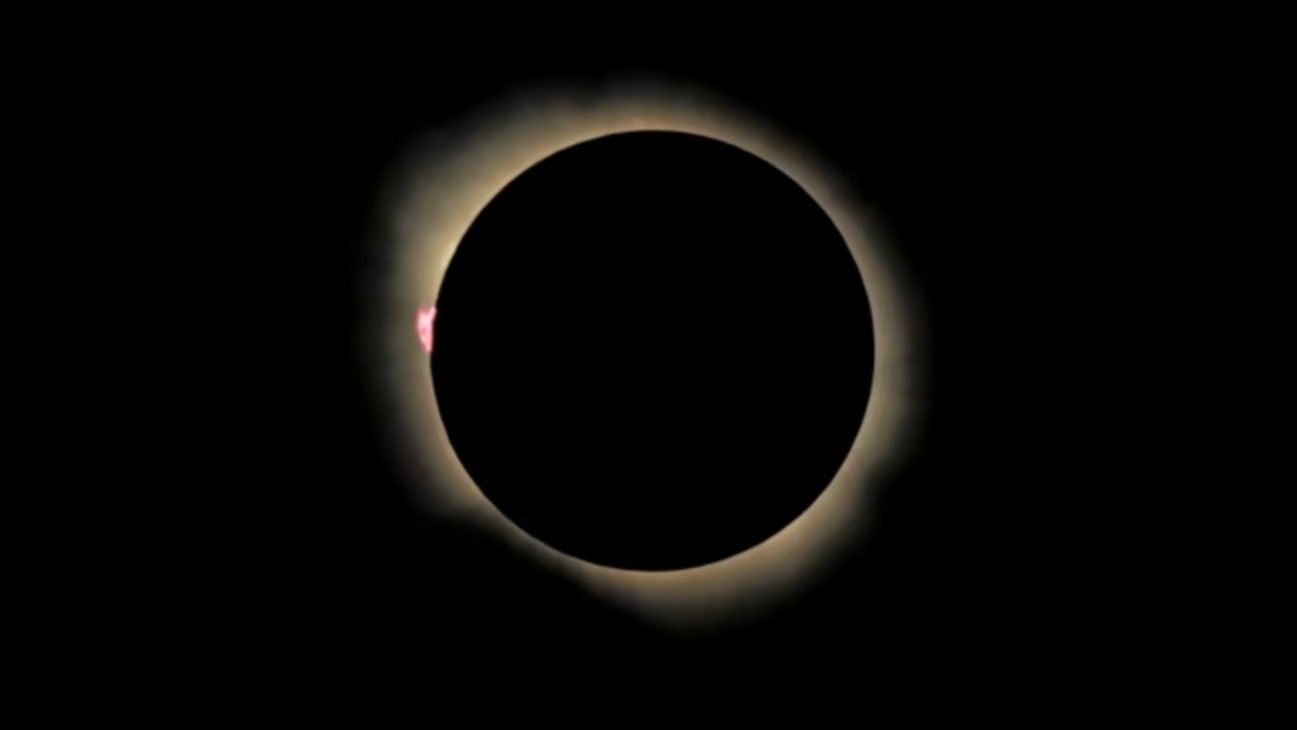
A total solar eclipse crossed northern Spain on August 12, 2026, with NASA scientists capturing the first images of totality during a special livestream. The moon completely blocked the sun's visible surface for roughly 90 seconds, plunging the daytime sky into twilight and revealing the solar corona, the star's wispy outer atmosphere.
One image taken with a solar-filtered telescope shows the moon as a black circle surrounded by white spikes of coronal light. The corona remains a scientific puzzle because it reaches temperatures of millions of degrees, far hotter than the sun's surface, and researchers are still uncertain why.
On the left side of the same image, a bright-pink structure extends from the solar surface. This feature is a prominence, a towering loop of plasma suspended by powerful magnetic fields, not a solar flare. Prominences often measure many times taller than Earth's width, making them clearly visible from 93 million miles away.
Another photograph taken just before totality captures Baily's Beads, bright points of light caused by the last rays of sunlight shining through valleys on the moon's rugged edge. Moments before and after totality, a similar diamond-ring effect appears when a single bead of light remains.
The path of totality, the track of the moon's dark inner shadow, ran from near the North Pole across Greenland, western Iceland, and into northern Spain. Observers outside this narrow corridor saw a partial eclipse, with up to 90% coverage in Europe and 10% to 25% in the northeastern United States and Canada.
Because the eclipse occurred during a new moon, the night sky remained especially dark for the peak of the Perseid meteor shower later the same evening. NASA estimated up to 75 shooting stars per hour could be visible under the moonless conditions.
The eclipse season continues with a deep partial lunar eclipse on August 27-28, visible across most of North and South America. The moon will take on a faint reddish hue as it passes almost completely into Earth's shadow. The next total solar eclipse, predicted to be the longest of the century, will cross southern Spain and northern Africa on August 2, 2027.
Totality! See the first photos of the Aug. 12 total solar eclipse over Spain
This is an independent summary. The complete reporting, supporting context and any primary documents remain with Live Science.