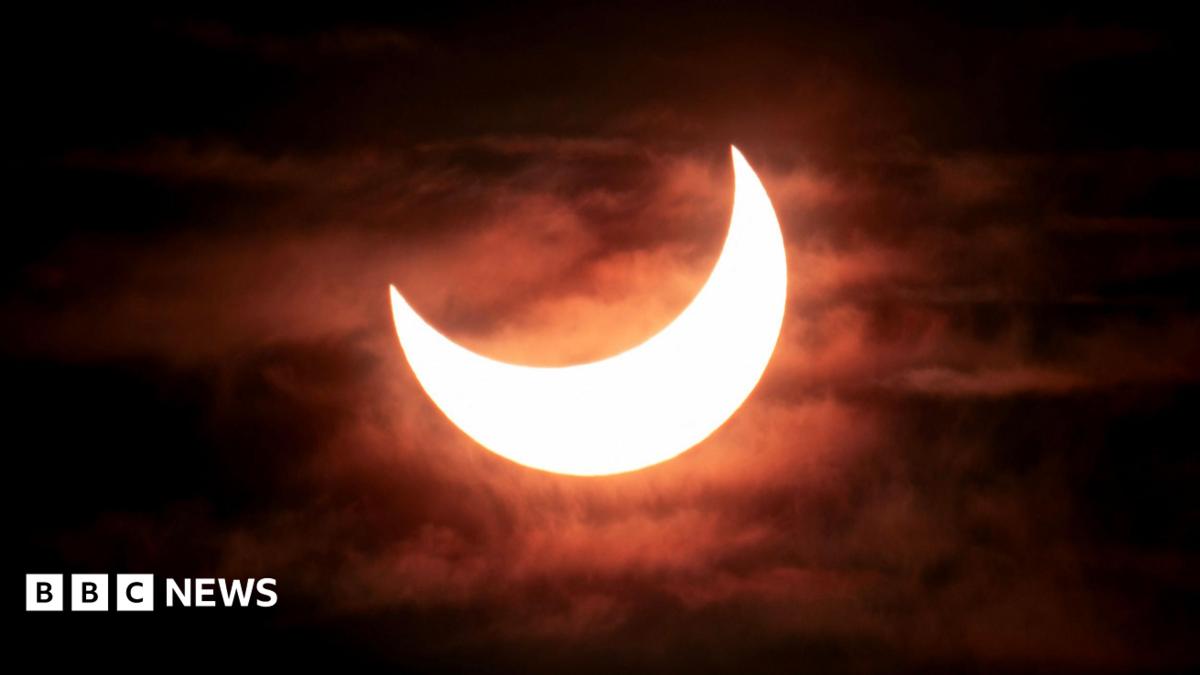
The UK will witness its most extensive solar eclipse since 1999 on Wednesday evening, with the Moon obscuring more than 90% of the Sun across the entire country. Peak coverage, between 94% and 96%, will occur in Devon, Cornwall and western Pembrokeshire between 18:58 and 19:15 BST. The rest of Wales, Northern Ireland, parts of the West Midlands, South West England and western Scotland will see 92% to 94% coverage.
A total solar eclipse, where the Moon completely blocks the Sun, will be visible along a narrow path crossing northern Spain, Portugal, Iceland, Greenland and Russia. In northern Spain, hundreds of thousands of visitors have gathered for up to one minute and 40 seconds of totality peaking between 20:26 and 20:33 local time. The next eclipse of comparable depth in the British Isles will not occur until 2081, with the next total solar eclipse in the UK forecast for 2090.
Weather forecasts suggest clear skies for much of the UK, though cloud and possible rain may affect viewing in northern England, north Wales, Scotland and Northern Ireland during the peak window. In Spain, clear conditions are expected in Bilbao, Valencia and Palma, Mallorca, while Barcelona and Madrid will see over 99% coverage.
Demand for certified solar viewing glasses has surged, with retailers reporting rapid sell-outs. Experts emphasise that standard sunglasses, welding goggles or phone cameras do not provide adequate protection; only certified eclipse glasses or indirect projection methods such as pinhole viewers should be used.
A solar eclipse occurs when the Moon passes between the Earth and the Sun, casting a shadow on Earth. Total eclipses happen roughly every 18 months globally, but the path of totality is narrow, meaning any given location experiences them rarely. During totality, the Sun's faint outer atmosphere, the corona, becomes visible as a pearly-white halo, along with a thin pinkish layer called the chromosphere.
In areas experiencing totality, the sudden darkening may briefly allow the Perseid meteor shower, which also peaks Wednesday evening, to become visible, though astronomers note the chances of spotting a meteor during the short totality window are extremely slim. The partial eclipse in the UK will not darken the sky sufficiently for meteors to be seen.
Martin Griffith, director of Brecon Beacons Observatory in Wales, described the event as "one of the great phenomena of nature," noting that having the path of totality cross accessible land rather than ocean is unusual. Eclipse chasers have travelled from across Europe and beyond to northern Spain for the spectacle.
Public interest has been high across the UK, with local authorities and astronomy groups publishing detailed viewing guides for major cities and regions. The event marks the most significant astronomical spectacle visible from Britain in over a quarter of a century.
UK to get best eclipse since 1999 as Moon blocks out Sun across Europe
This is an independent summary. The complete reporting, supporting context and any primary documents remain with BBC News.