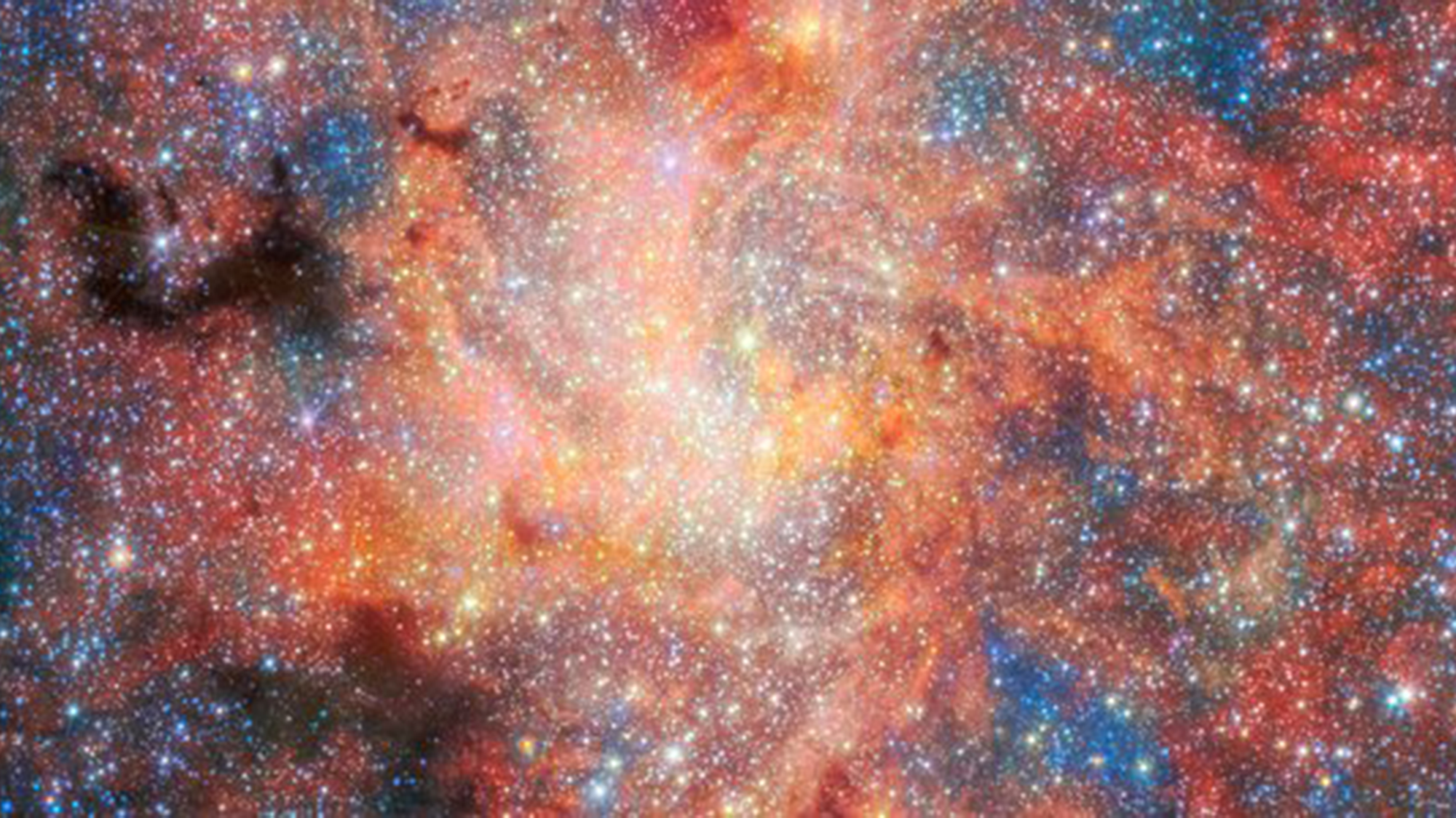
Astronomers have detected water and oxygen-rich silicate dust in the envelope of the aging star IRS 3, located only 0.55 light-years from the Milky Way's central supermassive black hole, Sagittarius A*. The findings, published August 11 in Astronomy & Astrophysics, come from combined observations by the James Webb Space Telescope's Near-Infrared Camera and Mid-Infrared Instrument.
IRS 3 is an asymptotic giant branch star roughly six times the mass of the Sun and about 72 million years old, with a luminosity around 60,000 times solar. In this late evolutionary phase, stars expel layers of material through strong stellar winds, seeding the interstellar medium with dust.
Previous studies had classified IRS 3 as carbon-rich based on the shape of its dust envelope. The new mid-infrared spectrum reveals two strong silicate features, indicating an oxygen-rich chemistry instead. Within this dust envelope, which extends about 10,000 astronomical units from the star, researchers also identified traces of water.
Temperatures in the envelope range from roughly 1,200 kelvins near the star to about 100 kelvins at its outer edge. The detection of water is notable because the region is dominated by intense radiation from the nearby black hole and surrounding stellar cluster, conditions previously thought to destroy molecular material.
Study co-author Macarena Garcia Marin of the European Space Agency said the result shows molecular material can survive in such a hostile environment. The observations challenge the assumption that galactic centers are too extreme for evolved stars to produce and retain dust and molecules.
The research team combined JWST spectral data with radiative transfer models to map the envelope's layered, shell-like structure. This marks the first time a continuous mid-infrared spectrum has been obtained for IRS 3, enabling a detailed chemical characterization.
The work was conducted under the Mid-Infrared Characterization of Nearby Iconic Galaxy Centers (MICONIC) program. Further observations of similar stars near Sagittarius A* could clarify how common this dust and molecule survival is in the galactic center.
IRS 3 lies approximately 26,000 light-years from Earth. The results provide a rare direct view of how an evolved star behaves in the immediate vicinity of a supermassive black hole.
Astronomers find water in the harsh environment near the Milky Way's black hole — Space photo of the week
This is an independent summary. The complete reporting, supporting context and any primary documents remain with Live Science.