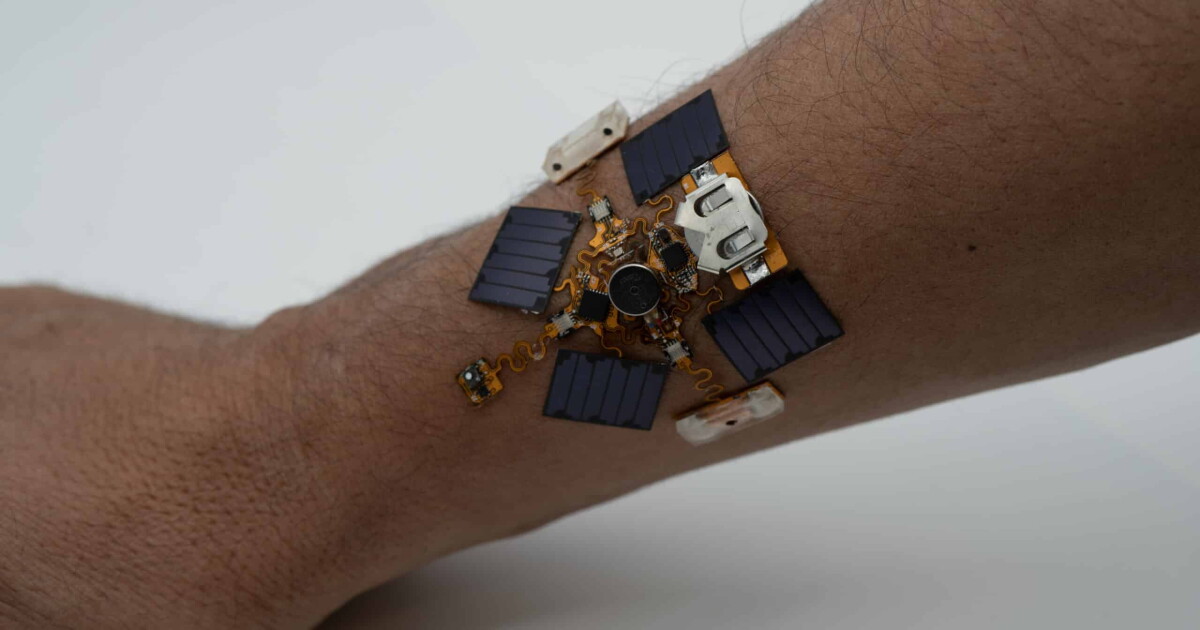
Researchers at North Carolina State University have developed a wearable patch capable of detecting gaseous, aerosolized, and aqueous environmental toxins. The prototype, roughly the size of a business card, integrates sensors for six hazards including heavy metals in water, dangerous gases, and toxic aerosols.
When a hazard is detected, the patch alerts the wearer by vibrating against the skin rather than sending a notification to a phone. Lead author Baha Erim Uzunoğlu, a PhD student, said the haptic approach ensures immediate awareness because users may not check a phone promptly.
Co-author Oluwatobi Ojuade, also a PhD student, explained that the team engineered textured surfaces at the motor-skin interface to create distinct vibration patterns. By varying the size and spacing of microscopic bumps, they encoded a tactile "Braille" that identifies which specific danger is present.
The patch contains its own battery, microcontroller, actuator, and sensor array, all enclosed in a photovoltaic skin that recharges from sunlight. Uzunoğlu said the energy harvesting extends battery life, allowing roughly 24 hours of continuous operation, which could be valuable in remote or disaster-affected areas without reliable electricity.
The researchers also developed a robotic "e-skin" made of piezoelectric material that converts the patch's vibrations into electrical signals. This allows a robot wearing the e-skin to detect hazards on behalf of a human operator, reducing the need for a person to enter a potentially dangerous environment.
Co-corresponding author Amay Bandodkar, an assistant professor of electrical and computer engineering, noted that the system uses mostly off-the-shelf components with a modular sensor array. This design should simplify scaling and allow customization for different hazard profiles.
Co-corresponding author Lilian Hsiao, an associate professor of chemical and biomolecular engineering, said the work demonstrates the feasibility of encoding tactile signals into wearable materials with sophisticated sensing capabilities, a goal the team has pursued for some time.
The study was published in the journal Device. The prototype remains at the research stage; no commercialization timeline or field-testing results were disclosed.
Your own personal poison-snooper as a wearable skin patch
This is an independent summary. The complete reporting, supporting context and any primary documents remain with New Atlas.