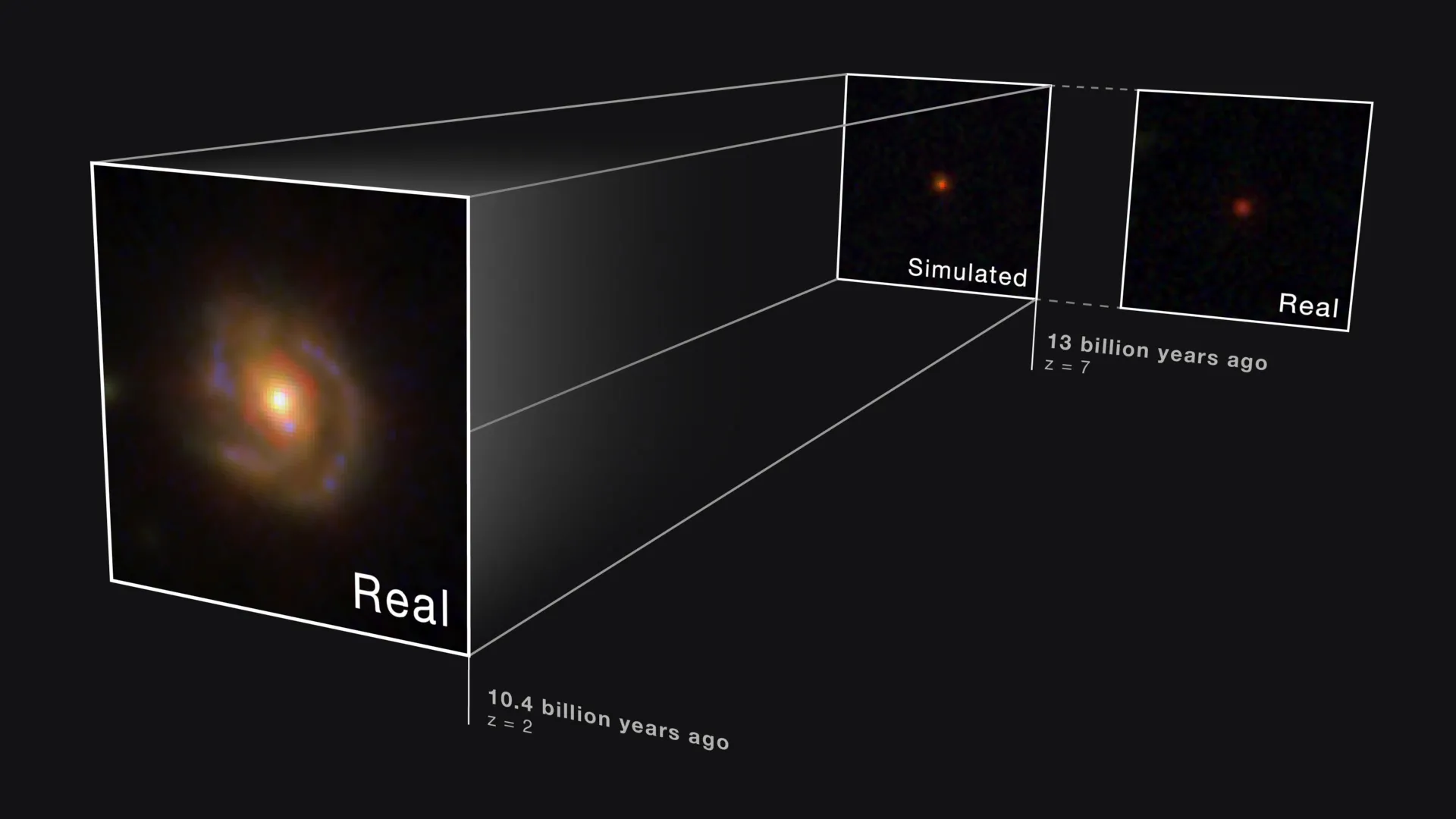
Since the James Webb Space Telescope first revealed them in 2022, little red dots have puzzled astronomers. These compact, extremely red sources appear abundantly in the early universe but decline sharply at later cosmic times, and their nature has remained uncertain.
A team led by Pierluigi Rinaldi of the University of Arizona's Steward Observatory, now at the Space Telescope Science Institute, studied a lower-redshift spiral galaxy designated WISEA J123635.56+621424.2 and nicknamed the Saguaro. The galaxy lies at redshift 2, corresponding to about 3.3 billion years after the Big Bang, and hosts a compact red nucleus that closely resembles a little red dot.
Using archival observations from both Webb and the Hubble Space Telescope, the researchers examined the nucleus across ultraviolet, visible, and infrared wavelengths. They also separated the nuclear light from the surrounding galaxy and analyzed X-ray data from NASA's Chandra X-ray Observatory, which detected weak X-ray emission from the nucleus.
The nucleus shines more strongly in ultraviolet and infrared than in visible light, matching a key characteristic of distant little red dots. The weak X-ray signal indicates an active galactic nucleus that is heavily obscured, a combination that could explain why most high-redshift little red dots are not detected in X-rays.
To test whether observational bias might hide the galaxies around distant little red dots, the team digitally shifted the Saguaro to higher redshifts. As the simulated distance increased, the spiral structure faded below detection limits while the bright central source remained visible, leaving an isolated dot.
The researchers propose that at least some little red dots are not a distinct class of object but rather a temporary phase of highly active, obscured supermassive black holes whose host galaxies are too faint to detect at extreme distances. The Saguaro may represent one evolutionary link between the early-universe population and later galaxies.
The authors caution that the Saguaro cannot account for every little red dot and that more observations are needed. The team plans to search for additional similar galaxies at lower redshift and to mine Webb's archive for a broader census of little red dots and their environments.
Webb’s mysterious little red dots may be hiding entire galaxies
This is an independent summary. The complete reporting, supporting context and any primary documents remain with ScienceDaily.