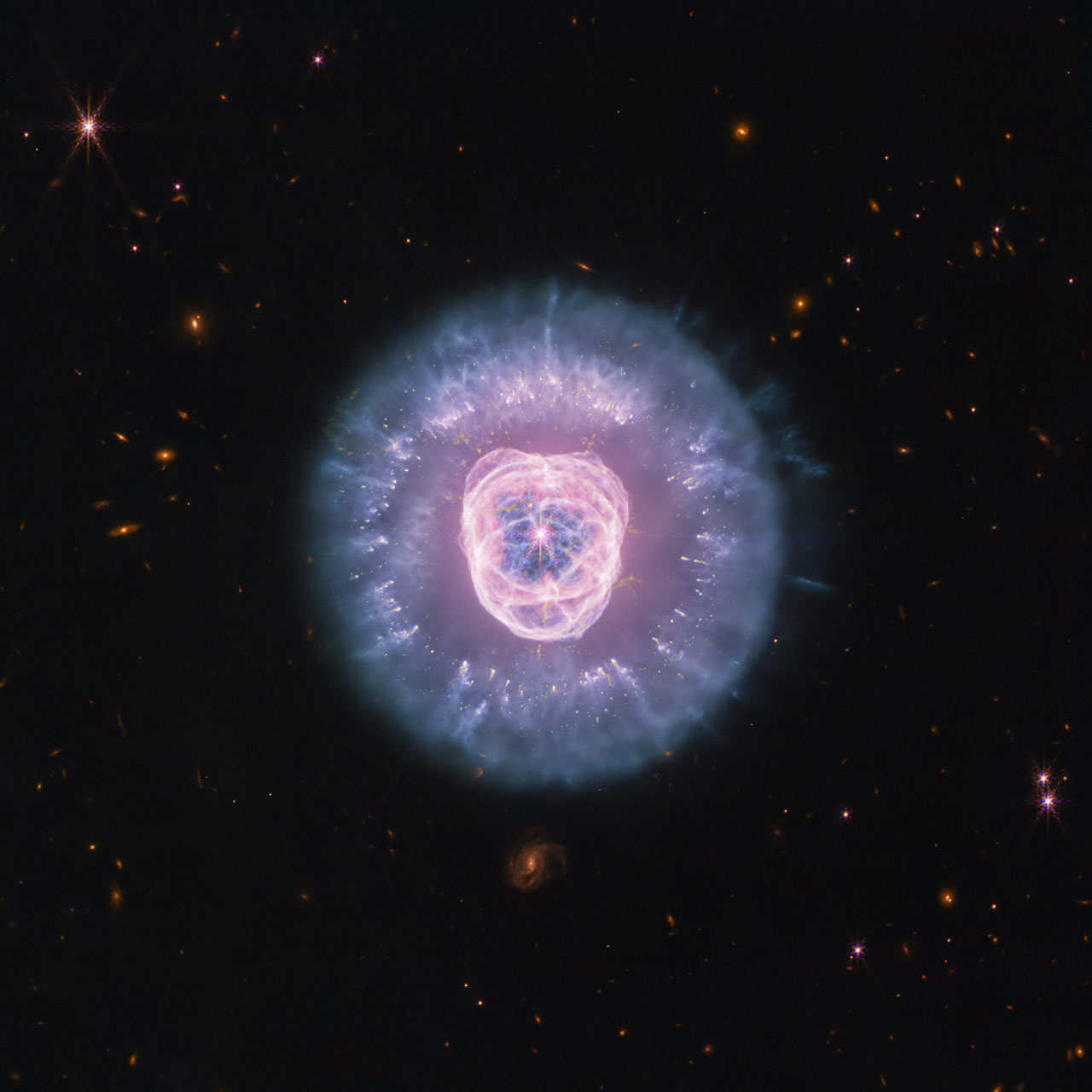
NASA's James Webb Space Telescope has captured new infrared images of NGC 2392, a planetary nebula nicknamed the Lion Nebula, using its NIRCam and MIRI instruments. The nebula lies roughly 5,000 light-years away in the constellation Gemini and represents the final stages of a star similar in mass to the Sun.
While the Hubble Space Telescope imaged the nebula in visible light in 2000, Webb's infrared view reveals features hidden by dust, including compact clumps that have survived the central star's intense radiation. These clumps form the 'tufts' of the lion's mane and shield material behind them from destruction.
At the nebula's center sits a hot white dwarf, the remnant core of the dying star. Its radiation and energy drive the expansion of a bubble of ionized gas that forms the lion's face, while simultaneously eroding the surrounding dust shells. The MIRI instrument highlights the contrast between dust being destroyed and filaments that persist.
Planetary nebulae like NGC 2392 are produced when lower-mass stars exhaust their nuclear fuel, become unstable, and shed their outer layers into shells of gas and dust. This process enriches the universe with much of its observable dust, yet the reason for the complex rings and shells seen in many such nebulae remains an open question.
Astronomers estimate the Lion Nebula will disperse completely in approximately 10,000 years, a brief moment in astronomical terms. Webb's high-resolution imagery effectively freezes this dynamic phase, allowing researchers to study the interaction between stellar radiation and circumstellar material in unprecedented detail.
The observations were processed by Alyssa Pagan at the Space Telescope Science Institute. Webb is an international program led by NASA with the European Space Agency and the Canadian Space Agency.
Lion Nebula Roars to Life With NASA’s Webb
This is an independent summary. The complete reporting, supporting context and any primary documents remain with NASA.