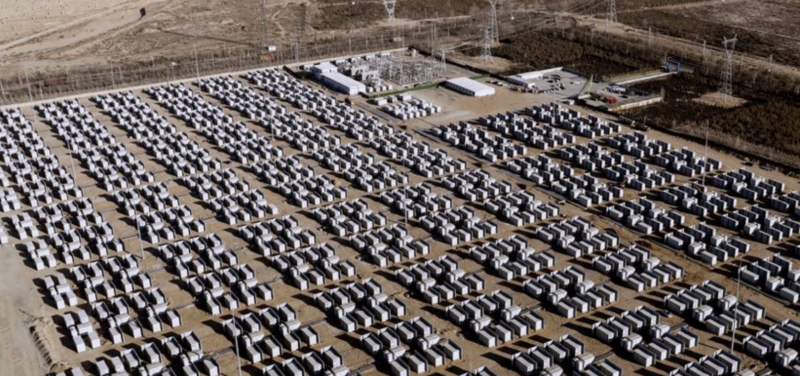
Envision Group announced the full commercial activation of the Jingyi Chagan Hada Energy Storage Power Station in Inner Mongolia, marking the completion of a 12.8-gigawatt-hour battery storage cluster the company describes as the world's largest single-site electrochemical storage facility. The flagship 4-gigawatt-hour plant passed three full charge-discharge cycles at rated power and a required 72-hour trial run on its first attempt, operating through winter temperatures on the Inner Mongolian steppe.
The system now incorporates artificial intelligence algorithms directly into its battery management systems to automate real-time operational decisions. According to Envision sources, the AI interfaces with local electricity spot markets, analyzing live price trends and demand forecasts to optimize dispatch schedules, while machine learning models monitor cell thermal behavior and coordinate charging cycles based on grid conditions.
Company engineers estimate the predictive software architecture will increase lifetime revenue by roughly 20 percent compared to conventional fixed-schedule storage assets. Live spot-market operations have demonstrated peak forecast accuracy across the regional power grid, validating the revenue model.
The Chagan Hada plant serves as the central anchor for a broader network of storage installations across Bayannur, Ordos, Hohhot, Ulanqab, Xilingol League, and Alxa League, bringing Envision's total operational storage footprint in Inner Mongolia to more than 14 gigawatt-hours. The development uses a localized supply chain for battery cell production, containerized assembly, and operational controls.
Inner Mongolia functions as one of China's principal clean energy hubs, generating substantial wind and solar capacity that frequently exceeds local grid capacity. Utility-scale battery clusters absorb surplus daytime generation and release stored electricity during peak consumption, reducing renewable energy curtailment and stabilizing ultra-high-voltage transmission corridors feeding eastern China.
Beyond grid buffering, the storage infrastructure now directly powers industrial computing infrastructure. Envision's Galaxy Campus in Ulanqab — a 2-gigawatt green energy AI computing industrial park designed to support up to one million accelerators — draws directly from regional wind farms and relies on the 12.8-gigawatt-hour storage cluster to deliver continuous, zero-carbon electricity to high-density compute infrastructure.
National power producers have accelerated large-scale storage procurement through 2026, including major framework tenders for lithium iron phosphate systems from state energy companies alongside demonstration projects for long-duration flow batteries and compressed air systems. The Chagan Hada cluster's commissioning reflects this ongoing expansion across China's utility-scale storage sector.
World’s Largest 12.8 GWh Battery Storage Cluster Activated in China
This is an independent summary. The complete reporting, supporting context and any primary documents remain with CleanTechnica.