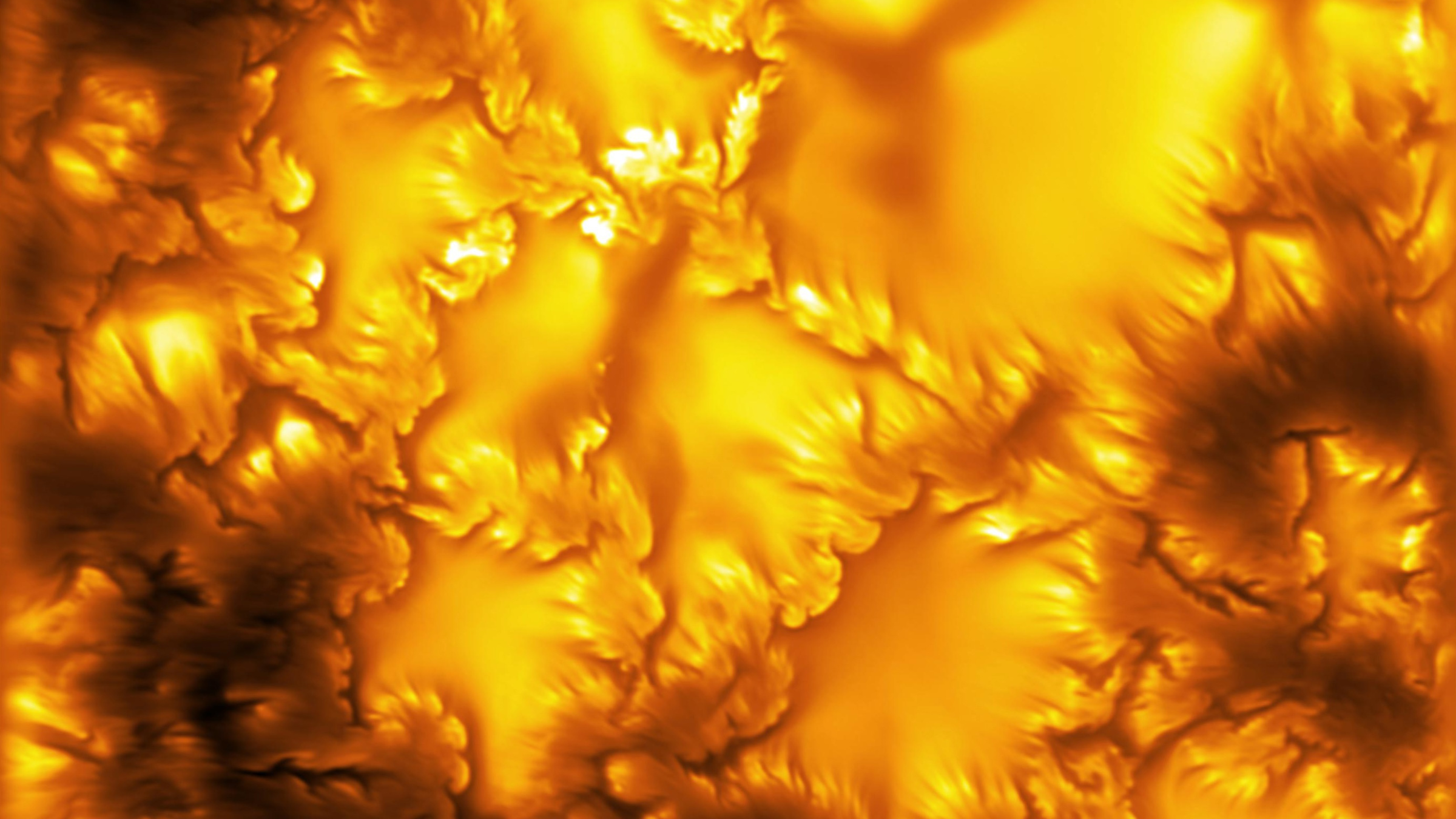
Scientists using the U.S. National Science Foundation's Daniel K. Inouye Solar Telescope in Hawaii have captured the highest-resolution images ever taken of the Sun's visible surface, or photosphere. The observations, published August 5 in Nature, reveal thousands of tiny whirlpools twisting across the solar surface, providing the first direct evidence of a phenomenon predicted 150 years ago.
The phenomenon, known as Kelvin-Helmholtz instability, occurs when two fluids slide past each other at different speeds, creating spiraling patterns. Physicists Lord Kelvin and Hermann von Helmholtz described the effect in the 19th century, but it had never been directly observed on the Sun until now, where the shear occurs between neighboring streams of solar plasma.
The telescope's resolution is sharp enough to distinguish structures just tens of miles across, a scale so fine that these vortices had gone completely undetected in previous observations. Time-lapse footage shows dozens of tiny vortices clustering along the edges of magnetic regions, some accompanied by delicate dark stripes called striations.
Researchers compared the images against computer simulations of the photosphere and found a close match, down to the average spacing between vortices, confirming they had captured the instability in action. The study was led by David Kuridze and colleagues from the National Solar Observatory and the Max Planck Institute for Solar System Research.
Beyond the visual detail, researchers suggest these swirls may serve an important function. By constantly twisting and mixing the Sun's magnetic field lines, the vortices may help build up the energy behind solar flares and coronal mass ejections, the explosive space weather events that can disrupt satellites, communications, and power grids on Earth.
The effect might also help explain a long-standing solar mystery: why the Sun's outer atmosphere, or corona, reaches temperatures of around 1 million degrees Celsius while its surface remains hundreds of thousands of degrees cooler. Thomas Rimmele, chief technologist at the National Solar Observatory, noted the instability could play a role in this coronal heating problem.
The team now plans to use computer programs to automatically track these vortices across future observations. This will help measure exactly how much the swirls contribute to heating the corona and driving explosive space weather, potentially improving forecasts of solar activity that affects Earth.
Most-detailed-ever view of the sun's surface revealed in new images from the world's largest solar telescope
This is an independent summary. The complete reporting, supporting context and any primary documents remain with Live Science.